NMC Guidelines for Doctors, Clinics and Hospitals in India
Every clause of the new NMC advertising rules in plain English: what you can post, what is banned, the grey areas, the penalties and the official PDF.
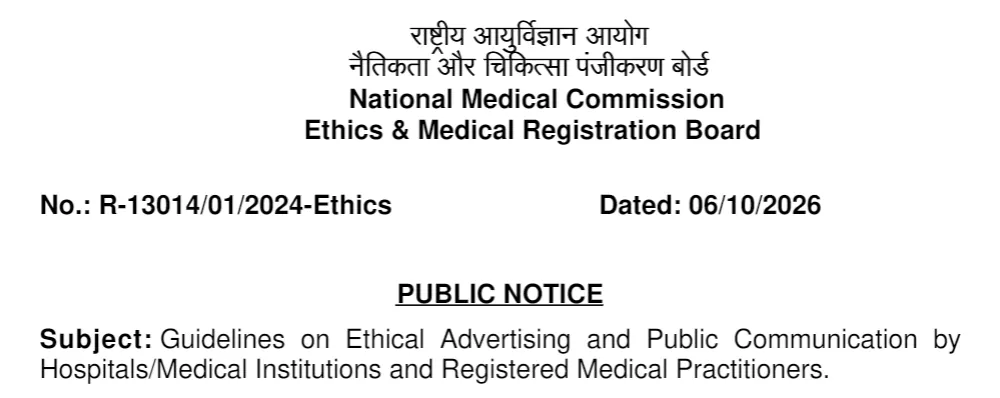 IN FORCE 06.10.2026
Quick Summary
- The NMC guidelines for doctors, clinics and hospitals in India apply from 6 October 2026, with no grace period.
- Doctors can share who they are, health education and formal announcements. They cannot promote themselves, paid or unpaid.
- Clinics and hospitals can advertise facts about themselves, but never a doctor as the face of the ad.
- No “best”, “No. 1”, testimonials, review requests, before-and-after photos or offers.
- Every online post needs the doctor’s name, qualifications and registration number.
- Penalties go from a warning up to removal from the medical register for 1 to 3 years.
What Are the NMC Guidelines for Doctors, Clinics and Hospitals?
The official name is long: Guidelines on Ethical Advertising and Public Communication by Hospitals/Medical Institutions and Registered Medical Practitioners.
The NMC issued them through its Ethics and Medical Registration Board on 6 October 2026. They apply from that same day.
The NMC guidelines for doctors, clinics and hospitals in India sit on top of older rules. Most of those rules are not new. The 2002 Professional Conduct Regulations already stopped doctors from advertising themselves. What is new is the detail. The NMC guidelines for doctors now name Google, Instagram, WhatsApp, reviews, influencers, agencies and AI.
The notice mentions a Supreme Court case, Writ Petition (Civil) No. 1160/2023, which questioned why hospitals could advertise when individual doctors could not. The NMC’s answer is simple: a hospital may share facts about itself, and nobody may promote an individual doctor.
- p. 1 to 2Public noticeWhy, the 7 aims, in force at once
- p. 3Clauses 1 and 2Name and purpose
- p. 4 to 6Chapter I, PreliminaryDefinitions, scope, awareness, patient privacy (3 to 6)
- p. 6 to 8Chapter II, Prohibition and exemptionSocial media, AI, data, live surgery (7)
- p. 8 to 10Chapter III, ResponsibilitiesThe 12 bans, 5 permissions, hospital ads (8)
- p. 10 to 11Chapter IV, Do’s and don’tsDirectories, photos, platforms (9)
- p. 11 to 13Chapter V, EnforcementPenalties, appeals, clarifications (10 to 12)
The 7 aims written into the notice
What changed from the 2002 Regulations
Who Do the NMC Guidelines Apply To?
Doctors
Doctors (registered medical practitioners)
Every clause applies to doctors on the NMC or a State Medical Register 3.7, including what an agency posts for them 4.4.
Clinics owned by a doctor
Doctor rules and institution rules apply together 3.43.7. The clinic may advertise facts in its own name, never the owner 8.3.
Clinics, hospitals and labs owned by others
Covered as institutions “in any recognised system of medicine” 3.4, through state clinical establishment law 4.3. A doctor who takes part answers personally 11.5.
Platforms and everyone else
Doctor listing platforms must not sell paid rankings 9.4. Consumer law, the Drugs and Magic Remedies Act and data law apply to every business.
Practitioners with their own councils
The practitioner rules bind NMC and State Medical Council doctors. These professionals follow their own codes, but their clinics can still fall under clause 3.4.
The NMC Rules on One Page
- Doctor: identity, education 8.2
- Clinic: facts about itself 8.3
- Doctor as face of a clinic ad 8.3(ii)
- Agency posts count as yours 4.4
- Name, degree, reg. no., fees 9.1
- Best, top, No. 1, most trusted 8.1(ix)
- Success rates, counts, awards 8.1(iii)
- Guaranteed, painless, cure 8.1(iii)
- Organic education anywhere Expl I
- Paid reach makes it an ad 3.2
- WhatsApp is an ad medium too 3.5
- Hoardings: facts only 5.2
- Fixed fee to an agency 8.1(viii)
- Per lead or per patient fees 8.1(vii)
- Offers and free consults 8.1(x)
- Government scheme campaigns 7.3
- Testimonials, even with consent 6.2
- Before-and-after photos 8.1(v)
- Asking for or sharing reviews Expl V
- Anonymised education 6.4
- Credential line on every post Expl III
- Real photo in a directory 9.1
- Photo on letterhead, signboard 9.2
- AI photo, avatar or voice 7.2(b)
The 3-Question Test for Any Post, Page or Ad
| It is about | Organic post | Paid or boosted |
|---|---|---|
| The doctor | Allowed Identity and announcements only | Not allowed Paid promotion of a doctor 8.1(ii) |
| The clinic or hospital | Allowed Facts about the institution | Allowed Facts only, no doctor as the face 8.3 |
| A health topic | Allowed Education in the doctor’s own name 8.2(iii) | Grey Only with nothing of the clinic attached |
How the NMC Guidelines for Doctors Change What You Post
This applies to your website, Google profile, Instagram, YouTube, WhatsApp and every ad, whether you post it or your agency does 4.4.
- Share name, degrees, specialty, registration number, address, timings and fees 9.1
- Announce starting practice, change of practice type, new address, absence, resumption, succession or fees 8.2(ii)
- Teach about diseases on TV, radio and online in your own name and designation, without promoting your employer 8.2(iii)
- Give health leaflets to patients at your clinic, with no guarantees 8.2(iv)
- Post greetings on national days and medical days, with no promotion 8.2(v)
- Share case studies you published in a reputed medical journal 8.2(i)
- Paying to spread an education video: only with nothing of your practice attached
- Your photo: identification size in a directory, never a hero banner 9.2
- “Practising since 2009” identifies you; “20 years of excellence” is an achievement
- AI drafts: check facts against medical sources and sign off yourself 7.2
- Condition images in an article: anonymised and consented 6.4
- Festival greetings: keep them plain, with no offer
- Run or boost ads that promote you, from any page 8.1(ii)
- Use best, top, No. 1, painless, guaranteed 8.1(iii) 8.1(ix)
- Show testimonials, before-after photos or success stories 8.1(v)
- Ask for reviews or reshare them Expl V
- Offer discounts, free camps as bait or referral rewards 8.1(x)
- Endorse a drug, device or product, paid or unpaid 8.1(iv)
19 things doctors often post, and the clause each one breaks
Red is what we see on profiles every day. Green is the safe swap.
How to show a doctor on a website or listing
A doctor directory with name, recognised qualifications, specialty, registration details and availability is patient information, not an ad 9.1. Never use an AI-made picture of a doctor.
Pune’s No. 1 Knee Surgeon
Dr [Full Name]
- Qualifications
- MBBS, MS (Orthopaedics)
- Registration
- [State] Medical Council, Reg. No. [number]
- Available
- Mon to Sat, 10 am to 2 pm
- Consultation fee
- Rs [amount]
From the notice
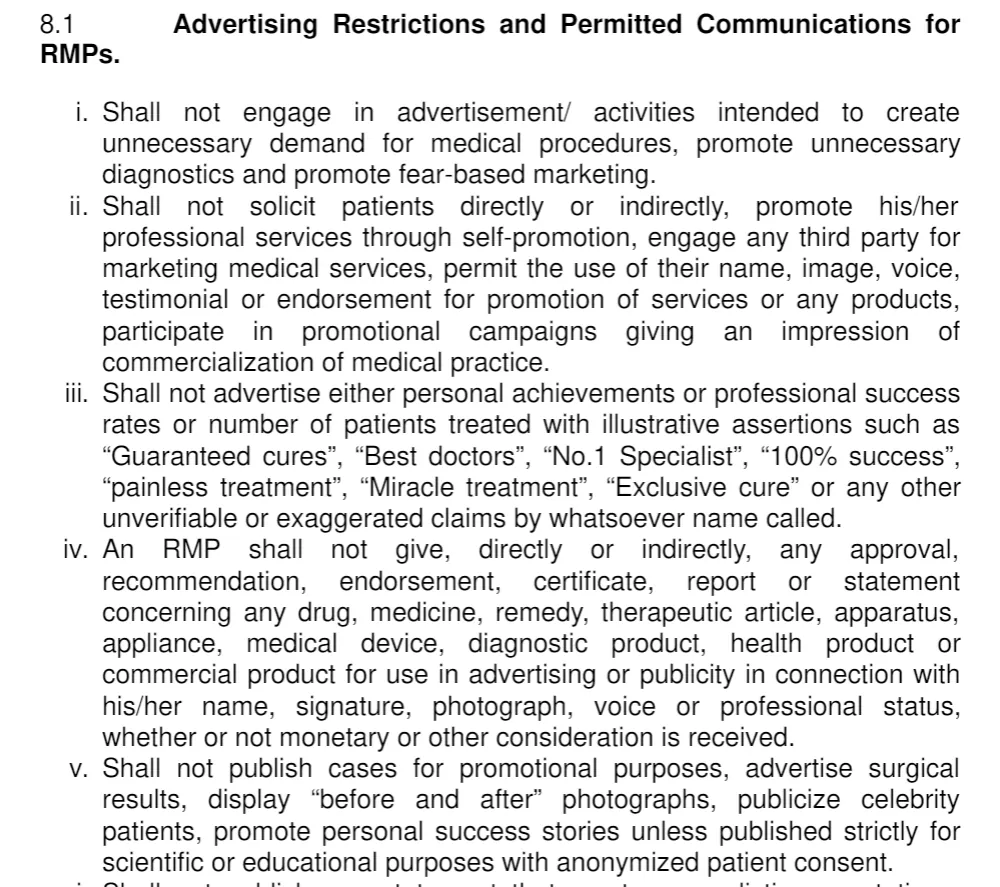
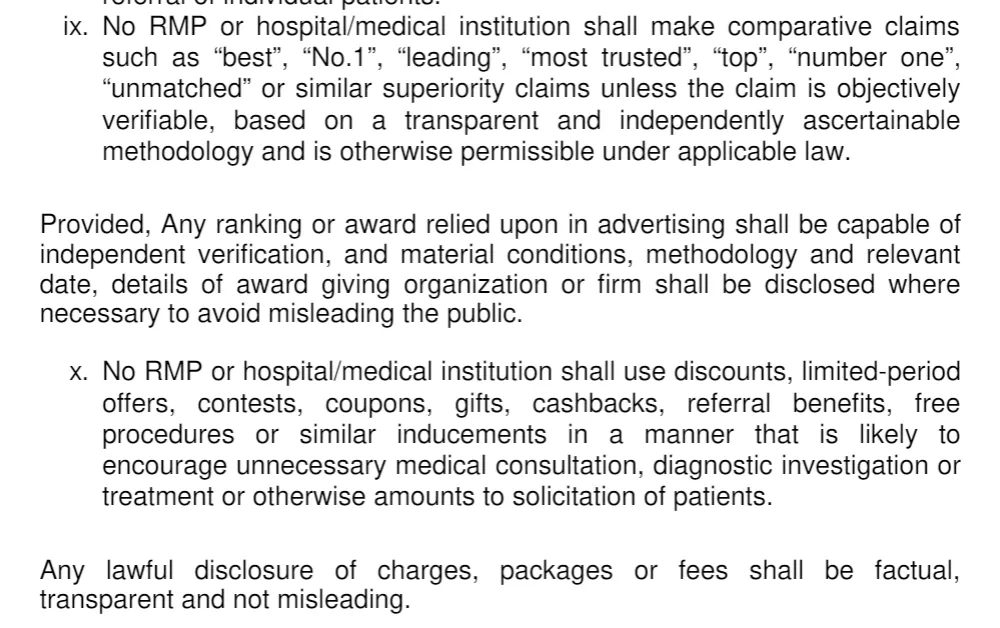
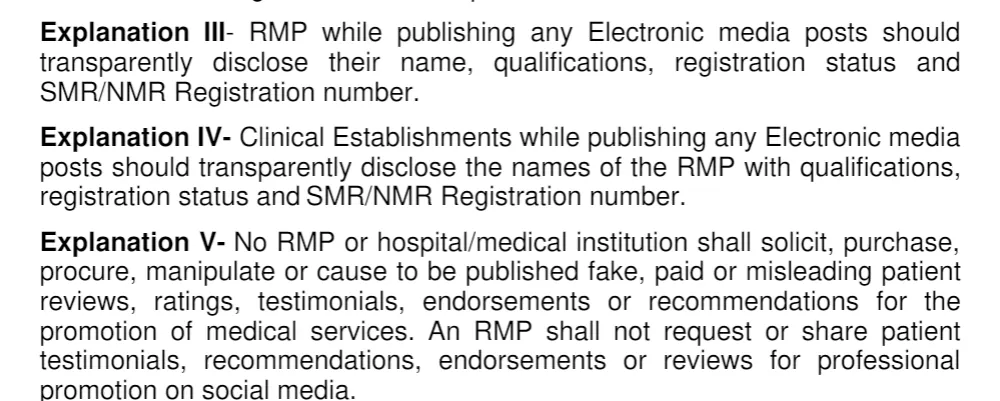
Clause 8.1 (i) to (v), page 8 · Clause 8.1 (ix) and (x), page 9 · Explanations III to V, page 4. Tap any extract to enlarge it.
NMC Guidelines for Clinics and Hospitals
Any doctor who authorised, took part in or endorsed a wrong ad can be examined separately by the medical council 11.5.
The facts a clinic or hospital may advertise 8.3(i)
What it may never add 8.3(ii)
Does ownership change anything?
Clinic owned by a doctor
Clinic owned by a non-doctor
Hospital or chain
“Welcome Dr X, renowned cardiac surgeon, 3,000 bypasses, trained abroad.”His portrait, boosted across the city. The hospital portrays a doctor 8.3(ii) and the doctor carries an achievements claim 8.1(iii). He and the medical director who approved it can both be examined 11.5.
“Cardiac surgery department now open. Cath lab, cardiac theatre, 24-hour cardiac emergency. Consultant: Dr X, MCh (CTVS), Reg. No. …”An announcement plus facts 8.3(i)9.1, plus a heart-health talk in his own name 8.2(iii).
“The NMC cannot touch our company”
That is only half true. Hospital violations go to the state clinical establishment law 4.310.1, and those laws say little about advertising.
But the Consumer Protection Act and the CCPA’s misleading-ad rules reach the company directly. The Drugs and Magic Remedies Act reaches anyone who publishes an ad claiming a drug or remedy treats one of its listed conditions. And every doctor in the campaign still answers to the State Medical Council.
NMC Rules for Google, Social Media and Ads
- Registered name exactly as on the signboard
- Accurate address, hours, categories, services and fees
- Premises and equipment photos; logo as logo
- Credential line for each doctor in the description Expl IV
- Polite replies to reviews patients left on their own, with no clinical details
- One small, captioned doctor photo in the gallery
- A listing that mixes clinic and doctor: split it into a clinic listing and a practitioner listing
- Experience in the description, never in the name
- A practitioner listing is never linked to ads
- “Best”, “No. 1”, “Top”, “25+ Years” in the business name 8.1(ix)8.1(xii)
- Review QR codes, review links, “rate us” cards Expl V
- Offer and discount posts 8.1(x)
- The doctor’s face as the cover photo
- Fake, duplicate or virtual-address listings 8.1(xii)
SEO is not banned. Clause 8.1(xii) targets manipulation that creates “a misleading impression of professional standing”. Making true information easy to find is neither.
- Technical SEO, speed, structure, and schema that describes real facts
- Doctor directory pages with the permitted fields 9.1
- Department, equipment and fee pages Expl II
- Doctor-written education with a byline and credential line
- Balanced procedure pages: benefits, risks, alternatives, who is not suitable 8.1(vi)
- Pages for “best doctor in [city]” searches: write a “how to choose” guide that ranks nobody
- Condition images inside education articles only, anonymised 6.4
- Journal papers: cite and link, never copy their images
- Enquiry forms: privacy notice and consent 7.6
- “Best”, “top”, “leading” in titles, headings, meta descriptions and alt text
- Testimonial sections, review widgets, star sliders Expl V
- Before-after galleries, including hidden ones 8.1(v)
- Doorway pages for areas where you do not practise
- Disease explainers, symptom guides and prevention tips in your own name 8.2(iii)
- The formal announcements as plain posts 8.2(ii)
- Greetings on national and medical days, with no promotion 8.2(v)
- Credential line on every post Expl III
- Clinic page posts about facilities, timings and fees
- Clinic page: one or two genuine, anonymised notes about the facility, never boosted
- Your photo: small and identifying, not a portrait-led creative
- Bio, highlights and pinned posts are content too; use social media “in the most responsible manner” 7.1
- Testimonial reels, patient journeys, transformations 8.1(v)
- Reposting reviews; asking for reviews Expl V
- Contests, giveaways, festival offers 8.1(x)
- Influencer “my experience at the clinic” posts 8.1(xi)
- OT footage or live surgery for promotion 7.5
- Identifiable patient faces, names or conditions 7.4
- Replies to patients who message you first
- Appointment confirmations and reminders
- Formal announcements to your own patients, such as a new address 8.2(ii)
- WhatsApp is named as an advertising medium 3.5
- Health tips to patients who opted in: education only, no pitch
- Patient numbers are personal data: consent first 7.6
- Promotional blasts to patient lists: reads as digital mass solicitation 10.1(iv)
- Review links sent after visits Expl V
- Offer messages and referral rewards 8.1(x)
The advertiser must be the clinic or hospital, and the copy must be facts. Search ads meet people who are already looking, which makes them the most defensible paid channel.
| Linked profile | Search ad, factual copy | Sponsored pin on Maps | Performance Max | Pay-per-lead formats |
|---|---|---|---|---|
| Clinic or hospital profile | Allowed8.3(i), 9.1 | AllowedThe pin is the clinic | High riskAuto-written headlines can add “best” | Not allowed8.1(vii) |
| Doctor’s own profile | Not allowedThe doctor is the paid subject, 8.1(ii) | Not allowed8.1(ii) | Not allowed | Not allowed |
The clinic’s ad carries the facts and the contact button. The doctor’s education video carries nothing of the practice. Put them together and both permissions disappear.
Ortho, physio, MRI on site. Mon to Sat. Fee Rs [amount]. Consultant: Dr [Name], MS Ortho, Reg. [no.]
Dr [Name], MS Ortho, Reg. [no.]. If you have these symptoms, see a doctor.
Dr [Name] explains. Visit us in [Area]. Call now.
- Hoardings and billboards with factual information: infrastructure, facilities 5.2
- Health pamphlets handed to patients at your clinic 8.2(iv)
- Formal announcements in the press 8.2(ii)
- Articles and talks on public health in your own name 8.2(iii)
- Interviews: talk about the disease, not your success
- Brochures: no guarantee of cure or superiority 8.2(iv)
- Unverifiable claims on hoardings 5.2
- Paid “news” articles that praise the doctor 3.5
- Doctor’s photo on letterhead or signboard 9.2
Can Doctors Use AI Under the NMC Guidelines?
AI promotional content that is otherwise allowed must carry a mark saying it was made by AI.
Fine
AI as a drafting helper for education, checked against medical sources and signed off by the doctor. AI for research, outlines and internal reports. AI diagrams that are clearly not real people, labelled as AI-made.
Label it
AI-generated promotional content that is otherwise allowed 7.2. Any AI image, voice or video where a viewer could mistake it for real 7.2(c). When in doubt, label it.
Never
AI patients, AI testimonials, AI before-after, or an AI photo, avatar or voice of the doctor 7.2(b). AI content that misstates diagnosis, outcomes or qualifications 7.2(a). Patient records in public AI tools without privacy safeguards 7.2(d).
Testimonials, Reviews and Before-After Photos
Praise, a result, a reason to choose you. Not allowed, even with consent.
Education or science. Go to Gate 2.
Face, name or identifying marks visible. Fix it first.
Specific, documented consent and fully anonymised.
What you can show, and where
| Where it appears | Patient praises the doctor or the result | Patient praises facilities or staff only | Patient explains condition and recovery | Before-after pair | Condition image alone |
|---|---|---|---|---|---|
| Doctor’s website or social | Not allowedReg 6.1.1, 8.1(v), 6.2 | Not allowedHere the “facility” is the doctor | AllowedEducation, anonymised | Not allowed8.1(v) | CareInside an education article |
| Clinic owned by a doctor | Not allowed8.3(ii); owner liable | GreyThe council looks through to the owner | Allowed | Not allowed | Care |
| Clinic or hospital owned by others | Not allowed for the doctor involved11.5 | Grey, most roomGenuine, unpaid, anonymised, occasional | Allowed | Not allowed for the surgeonThey are his cases | Care |
Google reviews: what a doctor can and cannot do
Before-after photos
Not on any website, profile, social page or ad that a doctor or clinic controls. Clause 8.1(v) allows them only for scientific or educational use with anonymised consent, such as in a medical journal.
If you cannot show before-after, show this instead
Condition guide
Illustrations of each stage, so readers recognise their own condition.
Recovery timeline
What day 3 and week 6 really look like, with risks. Honest, as 8.1(vi) asks.
Your published research
Cite and link your paper in a reputed journal 8.2(i), without copying its images.
"Who is it for" video
You explain who is and is not a good candidate for the procedure.
Loopholes in the NMC Guidelines? The Honest Version
Grey means the wording can be read two ways and no council has tested it yet. If a council disagrees with a careful grey choice, a warning is more likely than a suspension. It is still a risk to take knowingly.
13 grey areas, and how to stay on the safe side
1. Paying to spread a doctor’s education video Grey
Why greyClause 3.2 treats paid reach as advertising, but 8.2(iii) and Regulation 7.11 allow talks on diseases through electronic media in the doctor’s own name.
Stay safeTopic is the disease. Only name, degree and registration number. No clinic name, address, phone, link or booking. City-wide, no remarketing.
2. Paid ads for clinics and hospitals Grey on frequency
Why grey8.3(i) allows facts, but 8.3(ii) warns that “form, medium or frequency” can turn facts into solicitation.
Stay safeOnly permitted facts. No doctor as the face. Modest, steady frequency.
3. Bidding on “best doctor in [city]” Grey
Why grey8.1(ix) bans the claim, not the search. The patient typed “best”; your ad must not repeat it.
Stay safeFactual ad text, keyword insertion switched off.
4. SEO and Google rankings Untested
Why grey8.1(xii) bans manipulating search “to create a misleading impression of professional standing”. “Manipulate” is not defined.
Stay safeNo fake signals: no stuffed names, fake listings or bought links.
5. Facility feedback on a clinic’s own site Grey
Why greyThe second sentence of Explanation V names doctors, not institutions. 8.3(ii) still bans solicitation and outcome claims.
Stay safeCleanliness, staff and waiting time only. Genuine, unpaid, anonymised, one or two, never boosted. Never on a doctor’s own site.
6. Price pages and packages Protected
Why it worksThe last line of 8.1(x) protects “lawful disclosure of charges, packages or fees”.
Stay safeFull price, inclusions and exclusions, no “limited period”.
7. A doctor’s photo on a profile or listing Grey
Why grey9.2 bans the photo only “where such use constitutes” self-advertisement.
Stay safeReal, recent, profile-sized. Never AI-made.
8. AI-assisted articles Grey
Why grey7.2(c) asks for disclosure where the AI origin is “material to the audience’s understanding”.
Stay safeFact-check, doctor sign-off, and always label AI images.
9. Is a Google review page “social media”? Treat as yes
Why greyExplanation V’s request ban mentions social media; clause 3.6 defines it widely enough to include review platforms.
Stay safeDo not ask for reviews anywhere.
10. Dentists, AYUSH doctors and physios Partly outside
Why greyPractitioner rules bind NMC and state-registered doctors (3.7). Institution rules cover clinics “in any recognised system of medicine” (3.4).
Stay safeFollow the NMC standard anyway, then check your own council’s code.
11. Free health camps Grey
Why grey5.1 allows public health work; 8.1(x) bans “free procedures” used as bait.
Stay safeA genuine screening camp with no service pitch, or a government scheme campaign (7.3).
12. “Years of experience” Grey
Why grey“Practising since 2009” identifies. “20 years of excellence” advertises an achievement (8.1(iii)).
Stay safeA plain year in the profile, never in an ad headline.
13. Hiring a marketing agency at all Grey
Why grey8.1(ii) says a doctor shall not “engage any third party for marketing medical services”, yet 8.1(viii) expects doctors to hire digital marketing agencies, as long as payment is not linked to patients.
Stay safeScope lists only permitted tasks. Fixed fees. Every post approved by the doctor in writing.
10 “workarounds” that will not protect you
“An outside or foreign agency runs the ads, not me” Fails
Clause 4.4 makes you answer for what you “commissioned, sponsored, adopted or knowingly permitted”; 8.1(ii) bars engaging a third party to market your services; 8.1(xi) bans doing indirectly what you cannot do directly. Telling a council you do not know an agency when you do is a serious offence in itself.
“My agency posted it” Fails
Clause 4.4: an agency, platform or influencer does not take away your responsibility. Approve every asset in writing.
“The patient signed a consent form” Fails
Clause 6.2 was written to close exactly this route.
Hidden galleries and “DM us for results” Fails
Still advertising results (8.1(v)), now indirectly (8.1(xi)). Showing outcomes privately in a consultation is counselling; publishing them is not.
Staff ask for the reviews instead of the doctor Fails
The indirect route again (8.1(xi)). The request is still the doctor’s.
Running the doctor’s ad from the clinic’s page Fails
The council reads the ad, not the account name: promotional portrayal (8.3(ii)), and the doctor is examined anyway (11.5).
Choosing the “awareness” objective on Meta Fails
The dropdown label carries no weight. A clinic name, link or local radius gives the ad “promotional character” (3.2).
Paid “Top 10 doctors” articles Fails
A ranking paid for by those it ranks is not “independently ascertainable” (8.1(ix)), uses a third party (8.1(xi)) and misleads (8.1(xii)).
Influencer “my experience” posts Fails
Clause 8.1(xi) names celebrities, influencers, patients and employees. Paid relationships in allowed content must be disclosed.
Calling a promotion a “government scheme campaign” Fails
The exemption under 7.3 covers real Government of India and state programmes in the public interest, not a service promotion with that label.
Someone is running ads in your name. What now?
Act within days and keep a dated file. Clause 4.4 attaches nothing to content you did not permit, but months of ads landing on your number with nothing done can look like you “knowingly permitted” them.
Screenshots and ad library links
To Meta and Google
IT Act sections 66C and 66D
Disown the ads in writing
On your own profiles
If you can identify the sender
Dated, for any hearing
Penalties for Breaking the NMC Advertising Guidelines
Clause 10.1 sets a graded scale the council “may contemplate”. “Digital mass solicitation” is named as a serious violation, so it can go straight to step four.
The levels are from clause 10.1. The examples are our reading; the council decides the level in each case. Hospitals are dealt with under clinical establishment law (10.1 Explanation, 11.5).
What happens after a complaint
Anyone can send a screenshot to the State Medical Council.
No penalty before you are asked to explain 10.2.
In person or through a lawyer Reg 8.2.
It must name the violation, answer your points and give reasons 10.3.
To the NMC’s Ethics and Medical Registration Board, within 60 days 11.1.
To the Commission within 60 days of the decision 11.4.
Every Clause of the NMC Guidelines in Plain English
The notice and the purpose 11 clauses
- NoticeIssued by the NMC’s Ethics and Medical Registration Board on 6 October 2026, citing Supreme Court Writ Petition (Civil) No. 1160/2023 and the 2002 Regulations. In force immediately.
- 1.1The official name: Guidelines on Ethical Advertising and Public Communication by hospitals/medical institutions and registered medical practitioners.
- 1.2They come into force on the date the NMC publishes them.
- 2.1They exist to keep medical advertising and digital communication ethical, truthful, transparent and responsible, to protect patients from misleading claims, and to protect patient privacy and the dignity of the profession.
- 2.1 (a)Give a modern framework for medical advertising and promotion.
- 2.1 (b)Stop false, misleading, exaggerated or unverifiable medical claims. Information from doctors and hospitals must be factual and verifiable.
- 2.1 (c)Stop direct or indirect solicitation of patients that can push unnecessary tests, treatment or procedures.
- 2.1 (d)Regulate ads spread through digital and new technologies.
- 2.1 (e)Protect patient choice and privacy, and the dignity of the profession.
- 2.1 (f)Work alongside the NMC Act, 2019 and the 2002 Regulations, without overriding any existing law.
- 2.2Nothing in these guidelines allows anything that the law or the 2002 Regulations already ban.
Definitions and who it applies to 16 clauses
- 3.1“Act” means the National Medical Commission Act, 2019.
- 3.2An advertisement is any communication, in any medium, that directly or indirectly promotes a doctor’s or hospital’s services, reputation, skills, qualifications, achievements or facilities. Digital, social, sponsored, targeted, influencer, search, platform, audio-visual and AI content counts as advertising when its content or the way it is spread is promotional.
- Expl IInformation shared with the public in the normal course, without promotion or commercial intent, is not an advertisement.
- Expl IIEquipment, technology, diagnostic facilities and services may be shared as facts, without superiority, guaranteed accuracy or outcomes, comparisons or unverifiable claims.
- Expl IIIA doctor’s online posts must show name, qualifications, registration status and SMR or NMR registration number.
- Expl IVA clinic’s online posts must show the names of its doctors with qualifications, registration status and registration number.
- Expl VNo doctor or hospital may ask for, buy, manipulate or publish fake, paid or misleading reviews, ratings, testimonials or endorsements. A doctor may not request or share testimonials or reviews for promotion on social media.
- 3.3AI means a self-learning automated process or program that does tasks which usually need a human brain.
- 3.4A hospital or medical institution is any clinical establishment for diagnosis, treatment or care, in-patient or out-patient, in any recognised system of medicine, including those under the Clinical Establishments Act, 2010 or a state act.
- 3.5Advertising media include print, TV, radio, social media, websites, blogs, WhatsApp and other messaging apps, podcasts, influencers, digital campaigns, sponsored posts, AI promotion, interviews, promotional news articles and online healthcare platforms.
- 3.6Social media means any internet site or app where users create, share and join online communities.
- 3.7A registered medical practitioner is a doctor registered under the NMC Act, in the National Register or a State Medical Register.
- 4.1The guidelines cover doctors’ advertising, publicity, digital communication and promotion, and fill the gap created by electronic media.
- 4.2For doctors, they are read with the 2002 Regulations and the NMC Act. If they truly conflict, the law and regulations win.
- 4.3For hospitals, they are read with the Clinical Establishments Act or the state act. If they truly conflict, that law wins.
- 4.4Posting through a platform, agency, influencer or other intermediary does not free a doctor or hospital from responsibility for content it authorised, commissioned, sponsored, adopted or knowingly permitted.
Public awareness and patient privacy 6 clauses
- 5.1Doctors may take part in awareness programmes, public health campaigns, academic talks and educational content, as long as it does not promote their practice, solicit patients or get monetised through promotional marketing.
- 5.2Hoardings and billboards may be used by hospitals and doctors only for factual information like infrastructure and facilities. Unverifiable claims are banned.
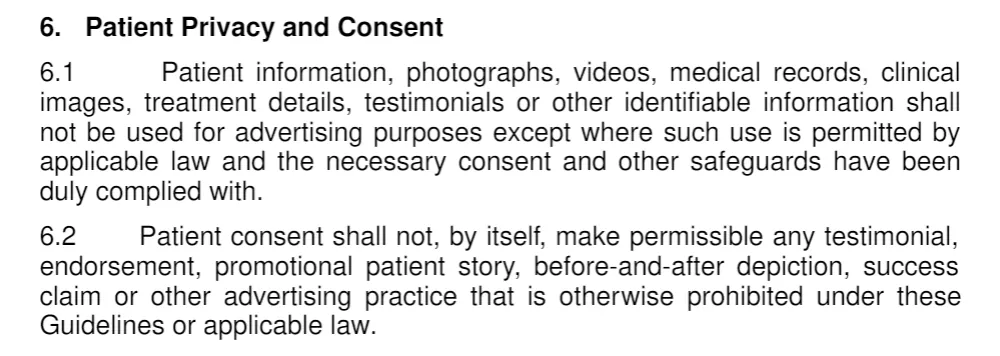
- 6.1Patient information, photos, videos, records, images, treatment details and testimonials may not be used for ads, except where the law allows it and consent and safeguards are in place.
- 6.2Patient consent alone never makes a testimonial, endorsement, patient story, before-and-after image or success claim allowed.
- 6.3Where consent is needed, it must be specific, informed, voluntary, documented and verifiable, and follow privacy and data protection law.
- 6.4Even when sharing is allowed, crop, blur or black out names, birthmarks and anything else that can identify the patient.
Prohibitions, AI and data 11 clauses
- 7.1Doctors and clinics must use social media responsibly, balancing public information with patient dignity and professional ethics.
- 7.2AI-generated promotional campaigns for commercial interest are banned. AI promotional content that is otherwise allowed must carry a mark saying it was made by AI.
- 7.2 (a)No AI content that misleads about diagnosis, treatment, outcomes, qualifications, patient experiences or services.
- 7.2 (b)AI may not create or alter a patient’s image, testimonial, voice or outcome, or create a fake endorsement or likeness of a patient, doctor or anyone else.
- 7.2 (c)Disclose AI-made or AI-altered content when its artificial nature would matter to the audience.
- 7.2 (d)Patient data used in an AI system must follow privacy, confidentiality, data protection and ethics rules.
- 7.3Chapter III governs the banned practices; the privacy, digital and AI rules of this chapter also apply.
- 7.3 ExplCampaigns on Government of India and state government programmes or schemes in the public interest are exempt.
- 7.4Do not share patient data such as names, faces or conditions that can identify them publicly.
- 7.5No live broadcast or commercial spread of surgery or procedures against the NMC’s live surgery rules.
- 7.6Ads that use personal data must follow the IT Act, 2000, the Digital Personal Data Protection Act, 2023 and its 2025 Rules.
What doctors may not do, and may do 20 clauses
- 8.1 (i)No ads that create unnecessary demand for procedures or tests, and no fear-based marketing.
- 8.1 (ii)No direct or indirect solicitation, self-promotion, engaging a third party to market medical services, letting your name, image, voice or testimonial promote services or products, or campaigns that look commercial.
- 8.1 (iii)No advertising of achievements, success rates or patient numbers, or claims like “guaranteed cure”, “best doctor”, “No. 1 specialist”, “100% success”, “painless”, “miracle” or “exclusive cure”.
- 8.1 (iv)No approval, endorsement or certificate for any drug, device, health or commercial product used in advertising with your name, photo, voice or status, paid or unpaid.
- 8.1 (v)No cases published for promotion, surgical results, before-and-after photos, celebrity patients or success stories, unless strictly for science or education with anonymised consent.
- 8.1 (vi)Nothing that creates unrealistic expectations, misstates outcomes, hides risks, or promotes unproven or secret remedies.
- 8.1 (vii)No commission, rebate, gift, referral fee or lead-generation fee connected with getting patients, specimens or referrals.
- 8.1 (viii)Agencies, influencers and platforms may not be paid in a way linked to individual patients.
- 8.1 (ix)No “best”, “No. 1”, “leading”, “most trusted”, “top” or “unmatched” unless objectively verifiable by an independent method. Any ranking or award must show method, date and awarding body.
- 8.1 (x)No discounts, limited-period offers, contests, coupons, gifts, cashback, referral benefits or free procedures used as bait. Fees and packages may be shown factually.
- 8.1 (xi)No celebrity, influencer, patient, employee or third party may promote you through banned testimonials. Paid relationships in allowed content must be disclosed. No using a third party to do indirectly what is banned directly.
- 8.1 (xii)No fake followers, likes, reviews, ratings, comments or views, and no manipulating search rankings to create a misleading picture of your standing.
- 8.2 (i)Allowed: research communication about case studies published in reputed medical journals.
- 8.2 (ii)Allowed: formal announcements on starting practice, change of practice type, new address, temporary absence, resuming practice, succeeding to a practice, and declaring fees.
- 8.2 (iii)Allowed: lectures and talks on public health and diseases on TV, radio and electronic media, in your own name and designation, without promoting your employer.
- 8.2 (iv)Allowed: health education pamphlets for patients at your clinic, without guarantees or superiority claims.
- 8.2 (v)Allowed: greetings on national days or days related to the medical profession, without promotion.
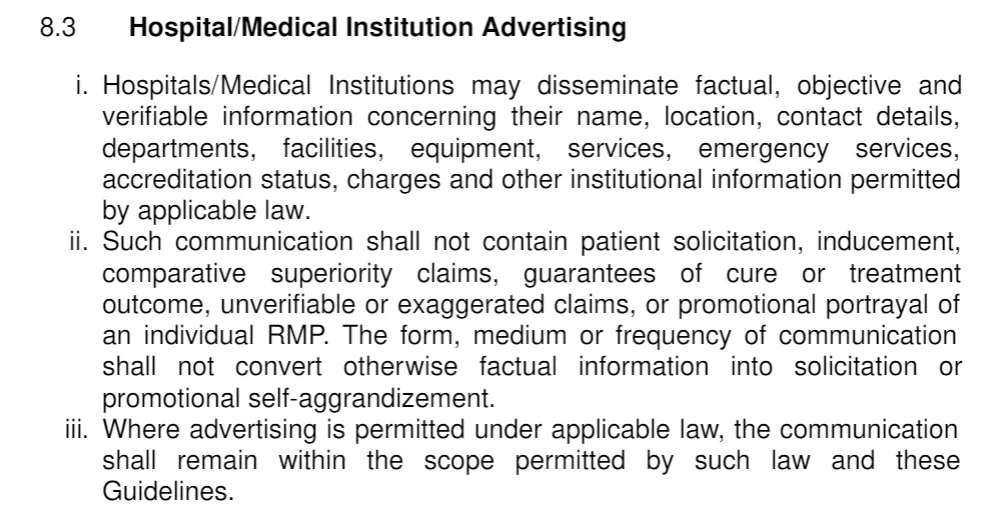
- 8.3 (i)Hospitals may share factual, verifiable information: name, location, contact, departments, facilities, equipment, services, emergency services, accreditation, charges and other information the law permits.
- 8.3 (ii)Hospital ads may not solicit patients, offer inducements, claim superiority, guarantee results, exaggerate, or portray an individual doctor promotionally. Form, medium or frequency must not turn facts into a sales push.
- 8.3 (iii)Where the law allows advertising, it must stay within that law and these guidelines.
Do's and don'ts for clinics, hospitals and doctors 4 clauses
- 9.1Clinics may advertise only objective, verifiable facts. A hospital website directory with doctors’ names, recognised qualifications, specialties, registration and availability is patient information, not an ad.
- 9.2A doctor’s photo may not be used where it is self-advertisement. A photo on a letterhead or signboard is unethical under Regulations 6.1.1 and 6.1.2.
- 9.3Formal announcements must be factual, non-promotional and limited in scope.
- 9.4Healthcare platforms listing doctors must follow NMC norms, must not sell paid rankings of doctors, and must be transparent about listings.
Penalties, appeals and clarifications 10 clauses
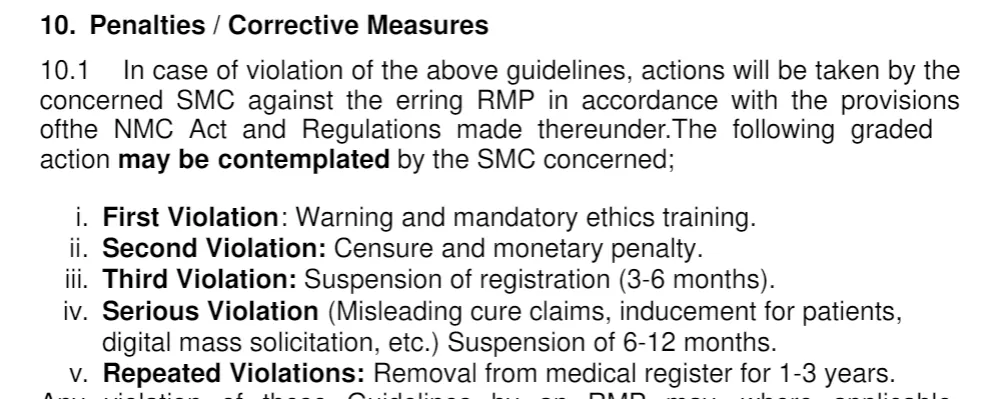
- 10.1The State Medical Council acts on violations, with a graded scale: warning and ethics training; censure and monetary penalty; suspension 3 to 6 months; suspension 6 to 12 months for serious violations like misleading cure claims, inducements and digital mass solicitation; removal for 1 to 3 years for repeated violations.
- 10.1 ExplHospitals and institutions are dealt with under the clinical establishment law that applies to them.
- 10.2No penalty without a show-cause notice and a chance to explain.
- 10.3The council must give a reasoned order: the violation, your arguments and why they were accepted or rejected, and the basis for the penalty.
- 11.1A doctor may appeal the council’s decision to the NMC’s Ethics and Medical Registration Board within 60 days under section 30(3) of the NMC Act.
- 11.2The appeal body examines it independently and may call for records, order a fresh assessment or seek more opinions.
- 11.3The appeal body gives a reasoned order that confirms, changes or sets aside the council’s findings.
- 11.4A second appeal lies under section 30(4) of the NMC Act, within 60 days of the first appeal decision.
- 11.5Hospital penalties and appeals follow clinical establishment law. A doctor who authorised, took part in or endorsed the content can still be examined separately.
- 12The NMC may issue clarifications, advisories and procedures to apply these guidelines uniformly.
NMC Compliance Checklist for Doctors, Clinics and Hospitals
Test your practice against the NMC guidelines for doctors, clinics and hospitals in India.
Try it: paste your bio, post or Google description
The checker marks common risk words and shows the clause they touch. It is a quick first look, not a legal review.
Download the Official NMC Guidelines PDF
Get a Free NMC Compliance Check
Send us your Google profile, website, social page or ads. We return a report with every issue marked, the clause it breaks and replacement text you can paste.
- Every post carries the credential line and goes live only after your written approval
- Clinic and hospital ads built only from permitted facts
- Doctor-reviewed education that ranks on Google and appears in AI answers
- Fixed fees, never per lead or per patient
- Your name never appears on our website, in our ads or in our pitches
Request your free check
Our team will contact you on WhatsApp or phone.
Frequently Asked Questions (FAQ)
What are the NMC guidelines for doctors in India?
They are the NMC Guidelines on Ethical Advertising and Public Communication, issued on 6 October 2026. They let doctors share health education, formal announcements and factual practice details, and ban self-promotion, testimonials, review requests, before-and-after photos, offers and superlatives such as best or No. 1.
When did the NMC advertising guidelines come into force?
On 6 October 2026, with immediate effect. There is no grace period, so check the posts, listings and ads that are already live.
Can doctors advertise in India under the NMC guidelines?
A doctor may not promote himself or herself in any medium, paid or organic. A doctor may publish identity details, formal announcements, health education in their own name and research published in reputed journals. A clinic or hospital may advertise factual information about itself.
Can a doctor ask patients for Google reviews?
No. Explanation V under clause 3.2 says a registered doctor shall not request or share patient testimonials or reviews for professional promotion on social media. Reviews that patients leave on their own may be answered politely.
Are before-and-after photos allowed under the NMC guidelines?
Not on any website, profile, social page or ad that a doctor or clinic controls. Clause 8.1(v) allows them only when published strictly for scientific or educational purposes with anonymised patient consent, such as in a reputed medical journal.
Can hospitals and clinics run Google Ads or Meta ads?
Yes, for factual information about the institution under clause 8.3: name, location, services, facilities, equipment, emergency services, accreditation and charges. The ad must not portray an individual doctor, use superlatives, guarantee outcomes or offer inducements.
Do the NMC guidelines apply to dentists, physiotherapists and AYUSH doctors?
Partly. The practitioner rules bind doctors registered with the NMC or a State Medical Council. Dentists, AYUSH and homoeopathy practitioners and physiotherapists follow their own councils’ codes. But clause 3.4 covers clinical establishments in any recognised system of medicine, so their clinics and hospitals can fall under the institution rules. Consumer protection, drug advertising and data protection laws apply to everyone.
Must doctors show their registration number on social media posts?
Yes. Explanation III says every electronic media post by a doctor should disclose the doctor’s name, qualifications, registration status and SMR or NMR registration number.
Can doctors use AI to create content under the NMC guidelines?
AI may help draft accurate, doctor-reviewed education. AI-generated promotional content must carry a mark saying it was made by AI. AI must never create fake patients, testimonials, outcomes or a synthetic version of the doctor, and patient data must not go into AI tools without privacy safeguards (clause 7.2).
Is the doctor responsible if the marketing agency posts something wrong?
Yes. Clause 4.4 says using an agency, platform or influencer does not free the doctor or institution from responsibility for content it authorised, commissioned, sponsored, adopted or knowingly permitted.
Can a doctor give a testimonial to a marketing agency or vendor?
Yes, a doctor can give a testimonial video to a marketing agency or vendor, but with caution. Clause 8.1(ii) says a doctor shall not permit the use of their name, image, voice, testimonial or endorsement for promotion of services or any products. So keep the testimonial about the vendor’s service only, give written consent, take no payment or discount in return, and make no claims about patients, results or your own practice.
What is the penalty for violating the NMC advertising guidelines?
Clause 10.1 sets a graded scale: a warning and ethics training for a first violation, censure and a monetary penalty for a second, suspension of 3 to 6 months for a third, suspension of 6 to 12 months for serious violations such as misleading cure claims or digital mass solicitation, and removal from the register for 1 to 3 years for repeated violations.
Can a clinic or hospital show photos of its doctors?
A real photo in a factual doctor directory, with name, recognised qualifications, specialty, registration details and availability, serves to identify the doctor (clause 9.1). A photo used as promotion, on a letterhead or signboard, or made with AI is not allowed (clauses 9.2 and 7.2).
Found, Identified and Read: How Doctors Grow Now
The NMC guidelines close the door on hard selling. They leave a wide door open for practices that inform well. That is now how patients choose, and how Google and AI answers choose who to show.
Vaibhav leads GrowthPixel, an NMC-compliant healthcare digital marketing agency working with doctors, clinics, hospitals and diagnostic centres across India.
Sources
- NMC Ethics and Medical Registration Board, Public Notice No. R-13014/01/2024-Ethics dated 06/10/2026, with the annexed Guidelines on Ethical Advertising and Public Communication.
- Indian Medical Council (Professional Conduct, Etiquette and Ethics) Regulations, 2002.
- National Medical Commission Act, 2019, sections 30 and 31.
- Consumer Protection Act, 2019 and CCPA Guidelines for Prevention of Misleading Advertisements, 2022; Drugs and Magic Remedies (Objectionable Advertisements) Act, 1954; Information Technology Act, 2000; Digital Personal Data Protection Act, 2023.