The Future of Healthcare Marketing: SEO, AI Search, and Voice-Based Patient Engagement
Imagine a patient searching for “care near me” at 11 p.m. They do not click a link. Instead, they read the AI-generated answer at the top of the page, pick a name, and call.
If that call goes to voicemail, there is a good chance they have already moved on to the next result before the ringing even stops.
That is how healthcare marketing works now.
It is no longer one straightforward funnel. It is a chain of small moments: a search, an AI-generated answer, a website visit, a phone call, a booking, and eventually a follow-up. A medical practice only needs to fumble one of those moments to lose the patient.
A major part of this shift is the growing role of Conversational AI in healthcare. Conversations that patients once had with a front-desk employee are increasingly being handled by systems that can hold a conversation, answer questions, schedule appointments, and follow up rather than simply playing a recorded menu.
Here is what is driving the shift, channel by channel.
Healthcare SEO Still Works, but Ranking #1 Is No Longer the Only Goal
Patients still use Google to search for symptoms and healthcare information.
They ask questions like:
- “Do I need a referral for a cardiologist?”
- “What is this rash on my arm?”
- “Where can I find an urgent care clinic near me?”
That behaviour has not changed.
What has changed is what happens after they hit Enter.
On searches where an AI Overview appears, click-through on traditional organic results has fallen significantly. One analysis found organic click-through rates dropping to roughly 1.6% compared with an expected 7.3% before AI Overviews, while users clicked through to a traditional result in only about 8% of AI Overview sessions versus 15% when no AI Overview appeared.
In other words, people are increasingly getting their answers without ever leaving the search results page.
That does not mean SEO is dead. It means the definition of success is changing.
Content still needs to rank, but ranking is no longer the finish line. It is the entry fee.
Healthcare pages that clearly answer specific questions, cite credible sources, demonstrate expertise, and avoid keyword stuffing have a better chance of becoming sources that AI-generated answers rely on. Professionals looking to deepen their understanding of digital strategy, consumer behavior, and brand communication may also consider advanced education such as a master’s degree in marketing.
Google’s core principles around relevance, authority, and page experience still matter. But there is now another layer of competition:
You are not just competing to be a search result. You are competing to become the source behind the answer.
Local SEO for Doctors, Clinics, and Hospitals
Healthcare is about as local as an industry gets.
Nobody wants to travel across the country for a routine dermatology appointment when there is a qualified provider nearby.
That makes local SEO critical for doctors, clinics, hospitals, urgent care centers, and other healthcare providers.
The fundamentals may not sound exciting, but they continue to carry significant weight.
Keep Your Google Business Profile Updated
Your Google Business Profile should contain accurate information about:
- Business hours
- Location
- Services
- Phone number
- Website
- Appointment options
Incorrect or outdated information can create friction before a patient even reaches your website. For a detailed overview, refer to our guide on Google My Business for healthcare professionals, including the key profile elements healthcare practices should keep updated.
Maintain Consistent NAP Information
Your name, address, and phone number (NAP) should remain consistent across directories, insurance listings, review platforms, and other online profiles.
Even small inconsistencies can make it harder for search engines and patients to determine which information is accurate.
Encourage Recent, Relevant Reviews
Reviews are another important trust signal.
A practice with a 5.0 average based on a handful of reviews from three years ago may not appear as credible as a practice with a 4.8 average and consistent reviews from recent patients.
Healthcare decisions are highly trust-driven, so recency and relevance matter.
Create Condition- and Location-Specific Pages
Instead of relying on one generic “Services” page, create focused pages for specific services, conditions, specialities, and locations.
For example:
- Dermatologist for acne treatment in [City]
- Pediatric urgent care in [City]
- Treatment for plantar fasciitis
- Women's health services in [City]
These pages give search engines and AI systems clearer information about what the practice actually provides.
Use Structured Data
Schema markup can help search engines better understand information about physicians, specialities, services, conditions, and healthcare organisations.
The same structured information can also make it easier for AI systems to understand who you are, what you specialise in, and where you provide care.
None of this is entirely new advice.
What is changing is the importance of these signals across multiple discovery channels. The same information that helps a practice appear in local search can also influence which healthcare provider an AI system recommends or mentions.
AI Overviews: The New Front Door to Healthcare Discovery
This is arguably one of the biggest changes happening in healthcare search.
A patient might ask an AI-powered search engine:
“What is the treatment for plantar fasciitis?”
The answer may be generated from information pulled from several sources.
If your healthcare organisation is referenced, your content may become part of the patient’s decision-making process.
If it is not, you may never get the opportunity to make an impression.
There is no traditional ten-blue-links experience to rely on. This shift is changing how patients discover and evaluate healthcare providers, from their first search to the eventual decision to seek care. Our guide on how AI is revolutionising the patient journey explores what this means for healthcare organisations.
What Makes Healthcare Content More Likely to Be Cited?
Content that performs well in AI-driven search tends to share several characteristics.
It:
- Answers one specific question clearly
- Uses straightforward, patient-friendly language
- Provides credible sources
- Includes visible author credentials
- Shows physician or expert review where appropriate
- Is regularly updated
- Avoids unnecessary marketing language
- Clearly explains complex medical topics
This is particularly important in healthcare because outdated information is more than an SEO problem. It can become a trust and patient-safety issue.
The practical shift for healthcare marketers is to think about answerability, not just keyword volume.
For example, a well-structured FAQ explaining post-operative recovery timelines may be more useful to an AI system than a polished service page containing hundreds of keywords.
The goal is to make the answer easy to understand, easy to verify, and easy to extract.
Healthcare Content That Actually Earns Trust
Healthcare content has always had a higher standard than content in many other industries, and it should.
Google’s E-E-A-T framework Experience, Expertise, Authoritativeness, and Trustworthiness is especially relevant when publishing medical information.
AI systems are also becoming more cautious about the sources they use to generate healthcare-related answers.
What High-Trust Healthcare Content Looks Like?
Effective healthcare content often includes:
- Articles written or reviewed by qualified physicians
- Clearly labelled author credentials
- Condition and treatment pages written in patient-friendly language
- Citations to credible medical sources
- Clear explanations of medical terminology
- Appropriate disclaimers and context
- A visible editorial or medical review process
- Regular updates when medical guidance changes
Healthcare content should also acknowledge nuance.
Instead of making broad promises, good content explains that treatment and outcomes can vary depending on the individual.
For example:
“Treatment depends on your symptoms, medical history, and individual circumstances. Speak with your healthcare provider for personalised advice.”
That kind of transparency helps establish trust with both patients and search systems.
This is an area where many healthcare practices underinvest.
It is tempting to publish as much content as possible. But in healthcare, two well-researched and genuinely useful pages can be more valuable than ten thin articles created simply to target keywords.
Website Conversion: Getting Found Is Not the Same as Getting Booked
Ranking well and appearing in AI-generated answers gets a patient to the door.
What happens next is a completely different challenge.
A practice can generate significant search traffic and still lose potential patients because its website makes booking unnecessarily difficult.
Four things matter particularly:
1. Make Booking Fast
A patient should be able to find an appointment and complete the booking process in as few steps as possible.
Ideally, the process should take less than a minute without requiring the patient to make a phone call.
2. Make Insurance Information Easy to Find
Insurance is often one of the first things patients want to know.
Do not make them search through multiple pages to find out whether their insurance is accepted.
3. Prioritize Mobile Experience
Healthcare searches frequently happen on smartphones, sometimes when a patient is uncomfortable, stressed, or in pain.
Buttons should be easy to tap, pages should load quickly, and important information should be visible without unnecessary scrolling.
4. Give Patients an Easy Way to Ask Questions
Not every patient is ready to book immediately.
Providing a simple way to ask a question through chat, messaging, or another low-friction option can prevent potential patients from leaving the site.
It is common to see a healthcare website that ranks well, attracts real traffic, and then loses potential patients at the booking stage because the process feels like too much work.
This is where working with a healthcare-focused SEO and digital marketing agency can make a difference.
The goal is not simply to generate traffic. It is to connect search strategy with what happens after someone lands on the website.
Voice Search for Healthcare Providers
Voice search never exploded quite the way marketers predicted several years ago, but it has steadily become part of how people find information and local services.
Patients can search through:
- Smartphones
- Smart speakers
- Car assistants
- Wearable devices
- Voice-enabled search tools
A query such as:
“Find care near me that is open right now.”
is fundamentally different from typing:
“What are the symptoms of plantar fasciitis?”
The first query has immediate local intent.
It is looking for:
- Now
- Near me
- Open
- Available
That means voice search overlaps heavily with traditional SEO but places additional emphasis on clear, concise information.
Healthcare providers should focus on:
- Accurate local business information
- Consistent NAP data
- Structured data
- Natural conversational language
- Frequently asked questions
- Location-specific content
- Accurate opening hours
- Clear service information
Voice optimization is not necessarily a separate SEO strategy. It is better viewed as another way patients interact with the information already being optimized.
AI Voice Agents in Healthcare: Fixing the Missed-Call Problem
This may be the most underrated part of the entire healthcare marketing journey.
Once a patient discovers a healthcare provider, a significant part of the experience often happens on the phone.
And that is exactly where a lot of marketing investment quietly disappears.
One analysis of 7,000 calls across 22 medical practices in 18 states found that medical offices missed an average of 42% of calls during business hours. The same research estimated that each missed appointment slot could cost a practice around $200 in lost revenue, while unused appointments contribute to more than $150 billion in annual costs to the U.S. healthcare system.
Separate research has also found that 41% of patients had switched providers at least partly because they could not get through by phone.
That is not a small leak in the funnel.
That is the door opening and closing on its own.
How AI Voice Agents Can Help?
AI voice agents are beginning to close this gap in ways that go beyond traditional automated phone menus.
For example, instead of sending a patient to voicemail at 7 p.m., an AI voice agent could:
- Answer the call
- Understand the patient's request
- Check appointment availability
- Schedule an appointment
- Confirm the booking
- Answer common questions
- Handle rescheduling
- Send reminders
- Escalate complex conversations to staff when necessary
This can be especially valuable for smaller healthcare practices that do not have staff available around the clock.
Platforms such as Murf are making AI voice technology more accessible for applications such as scheduling, reminders, and patient follow-up.
The quality of the voice matters, too.
Patients may tolerate a robotic voice when tracking a package, but healthcare is different. When someone is discussing their symptoms, appointment, or treatment, the interaction needs to feel natural and trustworthy.
Voice quality becomes part of the patient experience itself.
Used properly, AI voice agents are not about replacing the human side of healthcare.
They are about catching the leaks that used to cost practices patients before a human was ever involved.
Building One Consistent Patient Journey Across Channels
One of the biggest mistakes in healthcare marketing is treating every channel as a separate project.
An SEO team works on search visibility.
A content team produces articles.
A web team manages the website.
A separate vendor handles the phone system.
None of them necessarily communicate with each other.
But patients do not experience a healthcare practice in silos.
They experience one continuous journey:
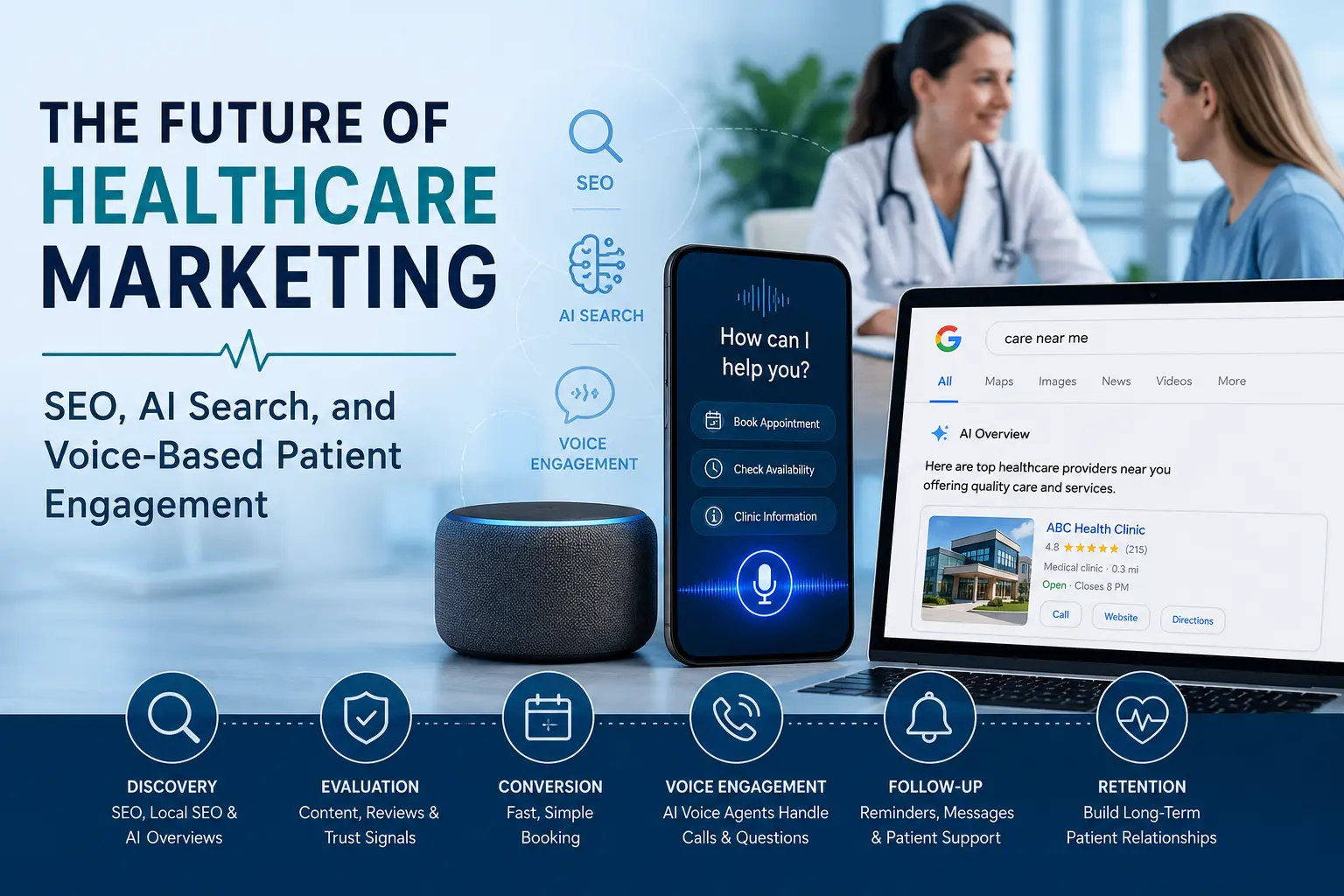
Search → AI answer → Website → Phone call → Appointment → Reminder → Follow-up
That is why healthcare marketing needs to move from channel-based thinking to patient-journey thinking.
The Modern Healthcare Marketing Funnel
Stage | What It Covers |
Discovery | Traditional search, local SEO, and AI Overviews help patients discover the practice. |
Evaluation | Reviews, credentials, content, and website experience build trust. |
Conversion | A fast, simple booking process turns interest into an appointment. |
Follow-up | Voice, messaging, reminders, and automated communications help keep appointments on the calendar and maintain the relationship. |
Each stage feeds the next.
A well-optimized website does not matter much if the phone system loses the patient immediately afterward.
The best AI voice agent in the world cannot compensate for a practice that nobody can find.
And strong SEO cannot fix a booking experience that forces patients through unnecessary steps.
The Future of Healthcare Marketing Is Connected
The healthcare practices that pull ahead over the next few years will not necessarily be the ones that dominate a single marketing channel.
They will be the ones that connect the entire patient journey.
Search visibility matters.
AI citations matter.
High-quality healthcare content matters.
Local SEO matters.
Voice search matters.
AI voice agents matter.
But their real value comes from how they work together.
The future of healthcare marketing is less about winning one channel and more about making sure nothing quietly drops the ball along the patient journey.
A patient may discover your practice through Google, learn about you through an AI-generated answer, evaluate you through reviews, visit your website, call an AI voice agent, book an appointment, receive an automated reminder, and eventually interact with a member of your staff.
From the patient’s perspective, that is not six different marketing channels.
It is one experience.
This connected approach is becoming increasingly important as AI reshapes how patients discover, evaluate, and interact with healthcare providers. Our guide to AI in healthcare marketing explores how these changes are affecting the way healthcare organisations reach and engage patients.
And the healthcare organisations that understand that shift will be better positioned to attract, convert, and retain patients in an increasingly AI-driven world.