
You’re probably reading this because someone you love has been limping for months and finally agreed to see someone. Or because your own knee has started waking you up at 4 AM and you can no longer pretend it’ll go away on its own. Or maybe a doctor at a corporate hospital told you that you need a knee replacement, and you’ve come home unable to decide whether to go ahead, get another opinion, or just live with the pain.
Hyderabad has plenty of orthopedic surgeons. That’s the problem. You search for an orthopedic doctor in Hyderabad, and 40 names appear, all with five-star reviews and all claiming to be the best. The decision still feels impossible.
This article won’t decide for you. What it will do is give you a more honest picture of five orthopedic doctors in Hyderabad. Their training. Their style. The kind of patient each one suits. So you can walk into a consultation knowing what to expect, rather than paying a consulting fee only to find that out.
The honest answer first. Most knee and hip pain in adults does not need surgery. Probably less than what gets recommended to you. So the most important question you can ask before picking an orthopedic surgeon is whether they tend to operate first or treat first.
For credentials, MS (Ortho) is the basic Indian qualification. MCh (Ortho) from the UK is an extra two to three years of focused training. FRCS is the British surgical fellowship that takes a few more years on top of that. None of these letters automatically make someone a better doctor for your specific problem. What matters more is how many cases like yours they handle in a year.
If your knee replacement surgeon does 30 knee replacements a year, that’s different from one who does 200. Ask the question. The good ones don’t mind.
Reviews online are useful, but read them properly. Five-star reviews saying “good doctor, recommended” tell you nothing. Three-star reviews from last month with specific complaints tell you a lot. Read those first.
Knee surgery is not like a haircut. You can’t redo it cleanly. A primary knee replacement that goes well lasts 15 to 20 years. A revision knee replacement, which is what you need if the first one fails, is technically harder, has a lower success rate, and usually doesn’t last as long.
So if the wrong surgeon does your first knee replacement, you don’t just lose money. You lose one of your two attempts.
Hip replacements are similar. If the leg length comes out off by even a few millimetres after surgery, you walk with a limp for the rest of your life. That sounds dramatic. It isn’t.
For sports injuries, the consequences play out over decades. An ACL tear that gets reconstructed badly, or rehabilitated poorly, leads to arthritis 10 to 15 years earlier than it should. The young patient who limped back to cricket six months after surgery doesn’t realise this until they are 45 and their knee is finished.
For elderly patients, unnecessary surgery can be worse than the problem. A hip replacement done at 75 when physiotherapy might have worked is a much bigger deal for the heart, lungs, and recovery time than it would have been at 55.
This is why the first consultation matters. Not the second one. The first.
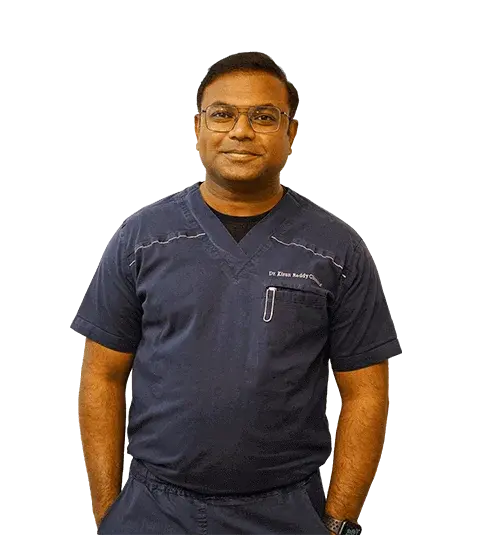
Dr. Kiran is a orthopedic doctor in Hyderabad who has been practising orthopedics for over 19 years and runs Kindle Clinics in Gachibowli. He holds an MBBS, an MS (Ortho), and an MCh (Ortho) from the UK. The thing worth noticing about his practice, more than the credentials, is what he does not push.
Most orthopedic clinics in Hyderabad recommend surgery sooner than necessary. Kindle Clinics has built itself around the opposite approach. The website lists six non-surgical options for knee pain, including autologous conditioned plasma, viscosupplementation, stem cell injections, bone marrow concentrate, cortisone injections, and cooled radiofrequency nerve ablation. Most clinics do not offer this range. Most surgeons do not even discuss them.
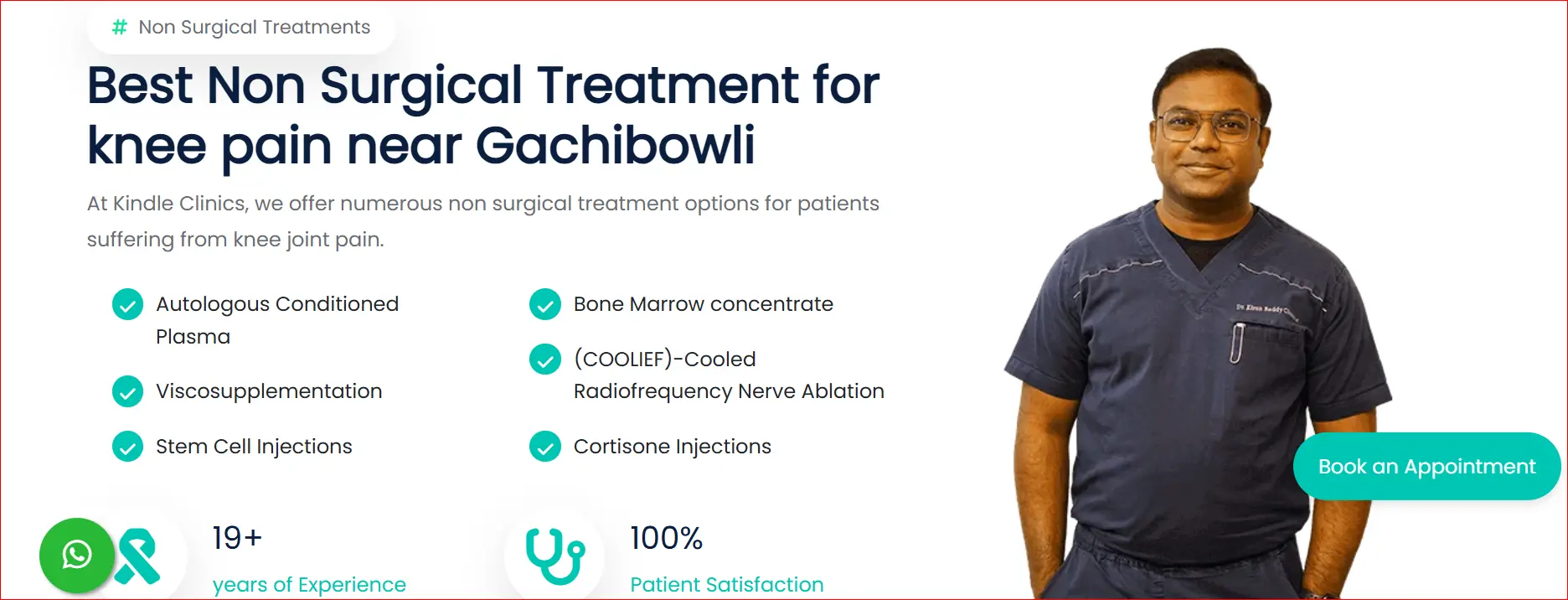
What patients keep mentioning in their reviews are two things: first, that he asks the right questions before prescribing. Second, that he tries to figure out the root cause before recommending treatment. One review specifically called out that he “prefers surgery when it is very much required in cases only.”
Another patient came in with neck pain and was routed through physiotherapy first, which worked. That’s a small detail, but it tells you about the clinic’s instinct.
His content reflects the same approach. The clinic’s Instagram runs educational reels (a recent one explained Vitamin D toxicity in plain language for patients, not other doctors). A YouTube testimonial features a patient who came in with an ankle fracture and was treated with two casts over six weeks instead of being sent for surgery. The patient was back to playing cricket by January. That kind of case is the practice’s signature.
Choose this clinic if you are in your 40s, 50s, or 60s with knee or joint pain that has not yet been treated, and you want a doctor who will exhaust non-surgical options before discussing replacement. Also worth considering for sports injuries: someone who understands return-to-sport timelines.
It might not be the right fit if you have already been told by two different surgeons that you need a knee replacement, and you are looking for someone to schedule the operation quickly. Dr. Kiran’s approach is methodical. That is a feature, not a bug, but it takes time.
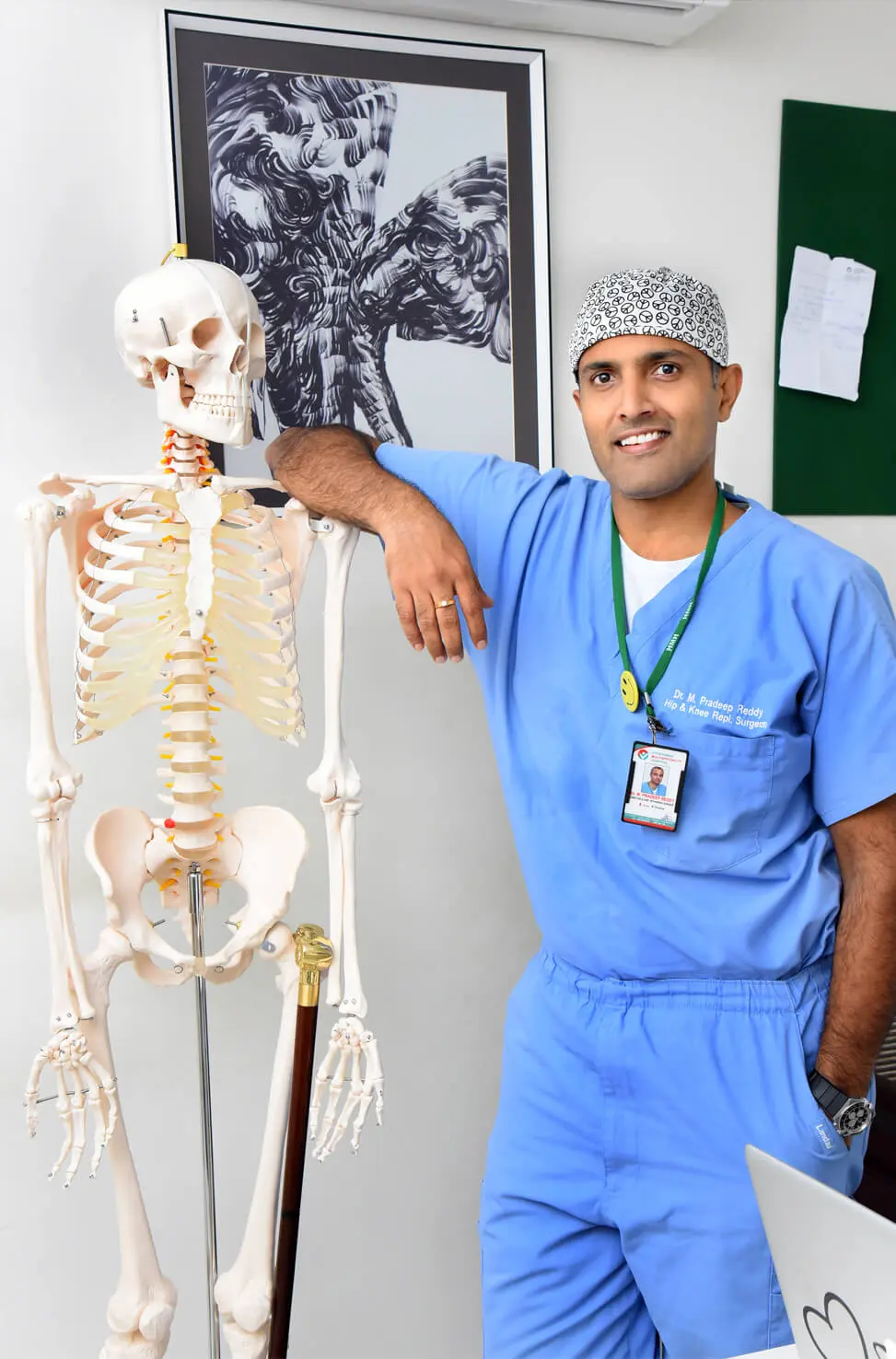
Dr Pradeep Reddy is one of Hyderabad’s senior joint-replacement surgeons. He holds an MBBS, an MS (Ortho), and an MCh (Ortho) and serves as the Director and Chief Joint Replacement Surgeon at Hyderabad MultiSpeciality Hospital. He also has consultant arrangements with Sri Srinivasa Hospital, BBR Super Speciality Hospital, and Century Hospital.
What patients seem to value about him is the time he gives. Multiple reviews note that he sits with patients, assesses their specific situation, and allows them to ask questions freely. One review put it well: “He prefers surgery when it is required in very few cases only. I never found a commercial nature in him.” That is an unusually direct compliment for a senior surgeon in private practice.
For hip replacement specifically, his work seems to be where his reputation runs deepest. A YouTube testimonial features Satyavati, a 62-year-old patient who had been struggling with severe hip pain for two to three years. She had tried multiple doctors and medicines, and nothing had worked. After hip replacement surgery with Dr. Pradeep, she was walking with a walker within days and reported sleeping through the night for the first time in months.
The honest caveat that comes up in reviews is parking. The clinic gets busy, parking is tight, and you should plan accordingly if you are coming with an elderly parent.
Choose him if you are in your 60s or older with severe hip or knee arthritis that has stopped responding to medicines and physiotherapy, and you want a surgeon with high-volume joint replacement experience.
It might not be the right fit if you need a quiet, low-volume clinic experience, or you live far from his consultation centres and need someone closer for follow-ups. The high patient volume that makes him experienced is the same volume that makes waiting rooms full.
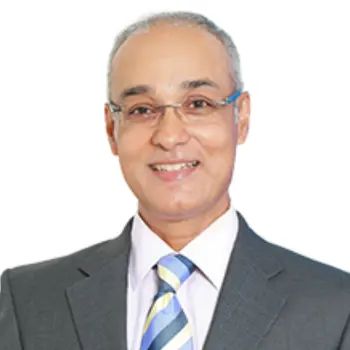
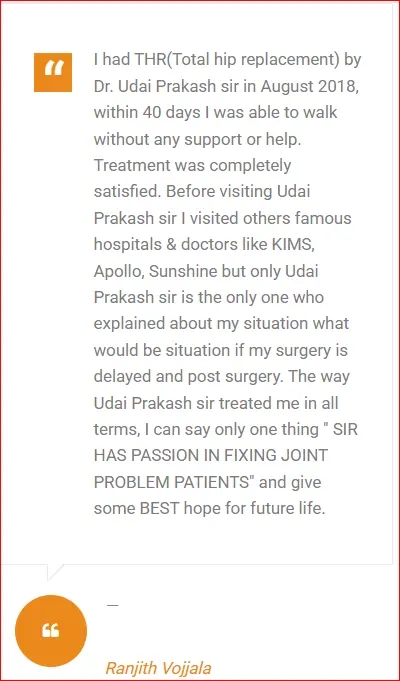
Dr Udai Prakash has a distinct profile compared to most orthopedic surgeons in Hyderabad. He trained primarily in the UK, completed his FRCS in both England and Edinburgh, and obtained a Certificate of Completion of Specialist Training, the UK’s specialist board certification.
He spent a year as a senior fellow in Australia, focused on hip and knee replacement and arthroscopy, then worked as a Consultant at the University Hospitals of Coventry and Warwickshire from 2002 to 2012. He moved to Hyderabad after that and is now one of the four directors at Udai Omni Hospital.
This is a doctor with an academic background. He has published in journals like BMJ, Hip International, and the Journal of Bone and Joint Surgery. He has trained orthopedic fellows from Australia and Europe, and demonstrated hip and knee surgery to visiting surgeons, including ABC fellows from the United States.
What does that mean practically? Two things.
First, his sub-speciality is complex joint replacement. So if you have had a previous hip or knee replacement that has failed, or if your case has been called complicated by another surgeon, this is the kind of training you want on your side. Robotic joint replacement is also part of the practice.
Second, his approach is conservative. One ACL patient review specifically mentioned that while many doctors recommended immediate surgery, Dr. Udai suggested starting with prehabilitation before surgery, followed by structured rehabilitation. The patient, who had been anxious about going under the knife, called the approach “thoughtful and reassuring.”
The hospital also runs a paediatric orthopedic team that handles clubfoot using the Ponseti method. If you have a child born with this condition, this is one of the few centres in Hyderabad with a structured program.
Choose him if you have a complex case, a previous joint replacement that has failed, or you specifically want UK-trained, academically-oriented care for a primary knee or hip replacement. Also for paediatric clubfoot.
It might not be the right fit if you want a quick consultation and to schedule a procedure the same week. The approach takes time, and the academic style is detail-heavy.
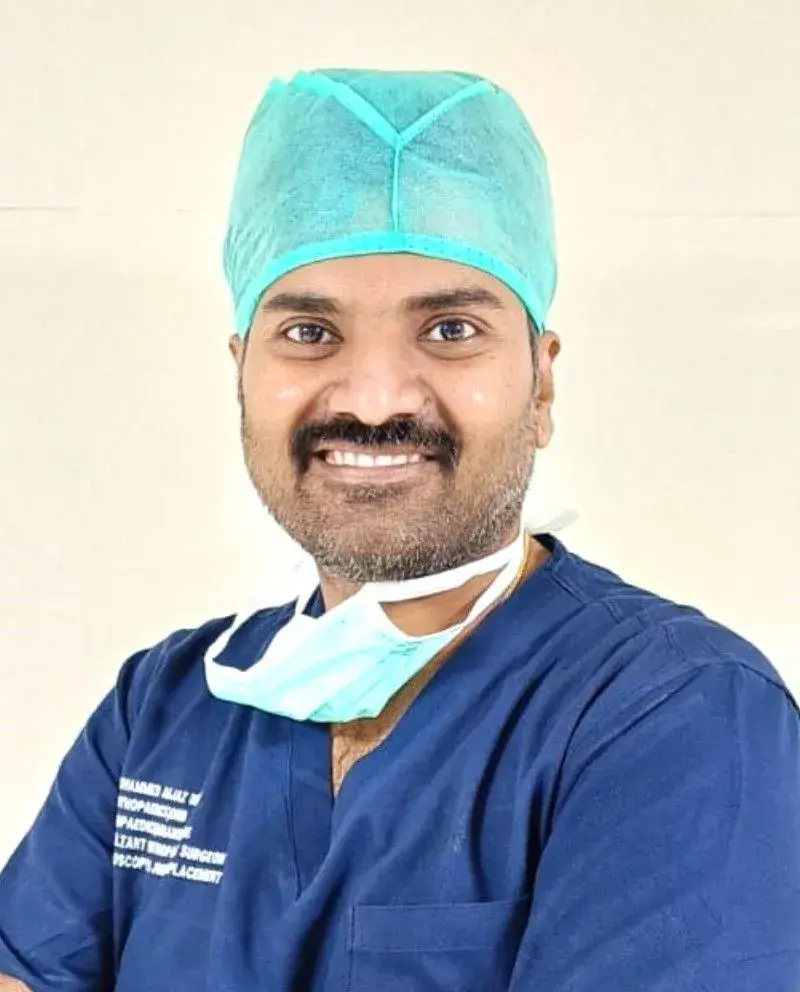
Dr. Raghuram practises at PACE Hospital and brings a slightly different training pathway. After his MBBS from Maharajah Institute of Medical Sciences in Vizianagaram, he completed his DNB in orthopedics at Baby Memorial Hospital in Kerala, then did a fellowship in Joint Replacement and Arthroscopy at MIOT International Hospital in Chennai. MIOT is one of the better-known orthopedic training programs in South India.
His patient feedback skews towards a specific theme: thoroughness with elderly patients. One detailed review described his approach to a grandmother’s knee condition. The reviewer noted that he conducted a careful clinical assessment, reviewed the imaging thoroughly, and developed a treatment plan that was “evidence-based and carefully customised considering her age, mobility, and overall health.” That kind of language, written that specifically, is rare in Google reviews. It usually means the family genuinely paid attention to how the doctor worked.
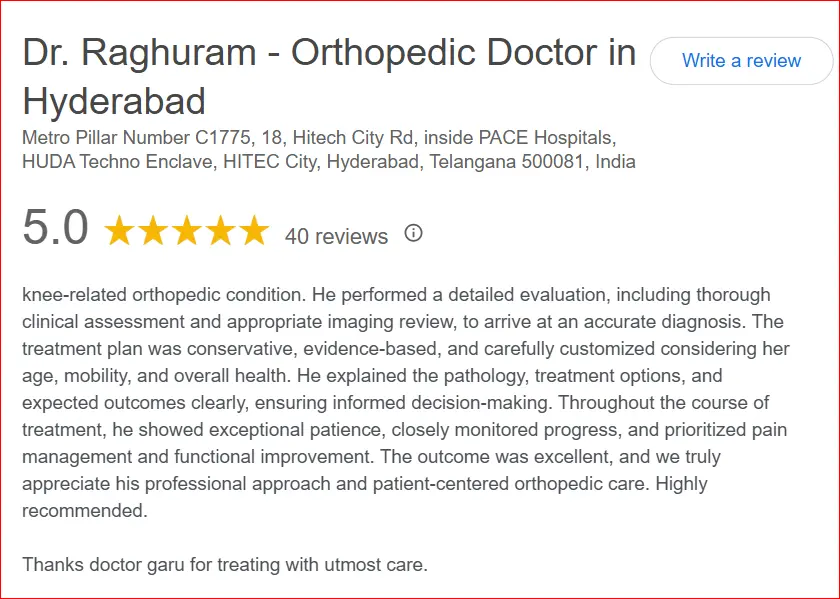
He also handles smaller orthopedic procedures that some senior surgeons no longer take on. A K-wire surgery for a thumb fracture was mentioned in one review. The patient described him as approachable and his explanation of the procedure as clear.
Choose him if you have an elderly parent with a complex orthopedic problem and you want a doctor who will properly account for age and overall health before recommending intervention. Also worth considering for smaller orthopedic procedures where you don’t want to go to a senior surgeon’s high-volume clinic.
It might not be the right fit if you specifically want a UK-trained surgeon, or you are looking for an academic or robotic surgery-focused practice.
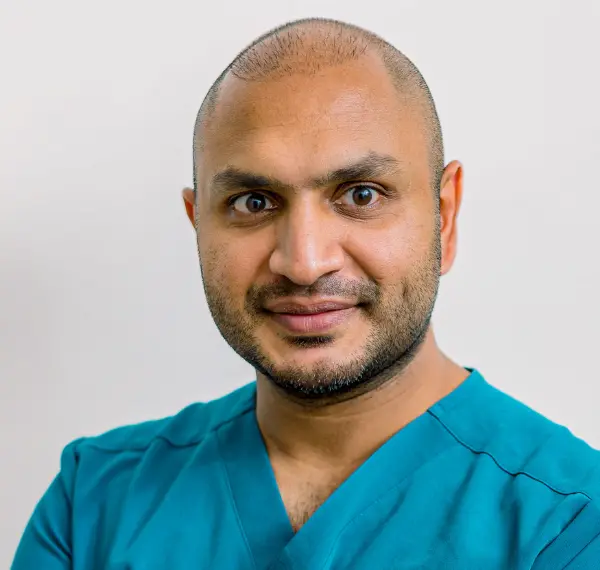
Dr. Vivekananda holds an MS in orthopedics and an MCh in orthopedics from the UK. He has roughly ten years of experience in orthopedic surgery. His sub-speciality interest is in minimally invasive knee replacement and what is called fast-track knee replacement, which involves shorter incisions, less tissue damage, and faster recovery times than traditional approaches.
He is the youngest surgeon on this list. That cuts both ways. On the positive side, the surgical techniques he trained in are more recent. Minimally invasive joint replacement is a relatively newer skill set, and surgeons trained in it more recently tend to do it more often. On the other hand, he has performed fewer surgeries overall than someone with 20 or 25 years of experience, and that volume matters for complex cases.
What patients keep coming back to in their reviews is communication. They mention the same thing in different words. He listens. He explains in language a layperson can follow. He avoids prescribing unnecessary medicines. One patient who fell off a bike and injured both knees mentioned that Dr. Vivekananda recommended an X-ray, then simple medicines and rest, and the patient recovered well within two weeks. No surgery was suggested where it was not needed.
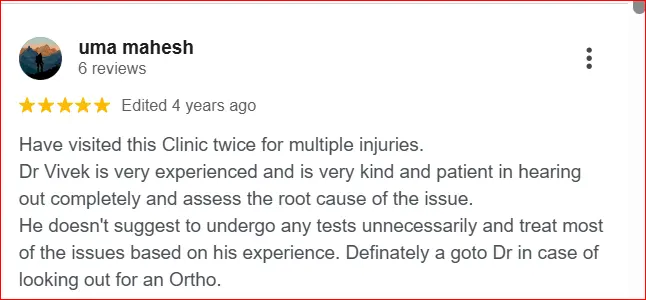
For ACL surgeries, the reviews suggest his careful approach. Patients reported that he took the time to perform clinical testing before recommending surgery, set realistic expectations for recovery, and ensured post-operative instructions were clear.
Choose him if you are younger and want minimally invasive knee replacement with newer techniques, or if you have an ACL injury and want a doctor who will explain rehabilitation properly, or if your priority is a doctor who communicates clearly without medical jargon.
It might not be the right fit if your case is complex or revision-grade. For first-time straightforward knee replacements and sports injuries, his profile fits well. For complicated cases, a more experienced surgeon may be the better choice.
If you want a non-surgical first approach to knee or joint pain, Dr Kiran Reddy Chennuri at Kindle Clinics specialises in that. Dr Kiran suggests surgery only when it is absolutely necessary.
If you have severe arthritis at 65+ and need a joint replacement from a high-volume senior surgeon, Dr Pradeep Reddy is a strong fit.
If your case is complex, you’ve had a previous joint replacement that failed, or you want UK-trained academic care, Dr. Udai Prakash is the profile to consider.
If you have an elderly parent and want a doctor who will properly account for age and other health conditions before recommending surgery, Dr Raghuram at PACE Hospital is worth considering.
If you are younger and want minimally invasive knee surgery or careful ACL management with clear communication, Dr Vivekananda is a good fit.
A few things worth asking on the phone before you even drive to the clinic.
How many of my specific procedures does the doctor do per year? Not in their career. This year. The good ones know the answer.
If I need surgery, what is the alternative? Every honest orthopedic surgeon should be able to explain what would happen if you delayed surgery or did physiotherapy instead. If that conversation does not happen, that is a problem.
Will the doctor be the one operating? In some hospitals, the senior surgeon consults, but a junior surgeon performs the procedure. This is common and not always wrong, but you should know.
What is the realistic recovery timeline? Not the optimistic version. The realistic one. A knee replacement does not feel normal for six to twelve months, even when it goes well. Make sure you hear this.
Is the doctor comfortable with me getting a second opinion? The answer tells you a lot about how the rest of the relationship will go. The good ones say yes without flinching.
What does follow-up look like? Some clinics include three or six months of follow-up visits. Some charge for every visit after the surgery. Worth knowing now, not after.
Five doctors. Five different styles. One patient deciding.
Picking an orthopedic surgeon is harder than picking most other specialists, because the cost of the wrong choice plays out slowly. You do not find out for months that the surgery should have been done differently. Or for years that surgery should not have been done at all. So take the time. Ask the questions. Get a second opinion if anything feels off.
If your case is straightforward, most of these five can probably help you. If your case is complicated, narrow down to the two or three whose specific training matches your problem.
And remember that the most important conversation is the first one. The doctor who takes 40 minutes with you before recommending anything is usually the one to trust, not the one who can fit you in tomorrow.
Whatever you decide, decide carefully. Joints don’t grow back.